
The Archevia Approach: creating space for meaningful growth
Growth does not always begin with a clear answer.
Sometimes it begins with a question, a sense that something needs to change, or the recognition that the way we have been working is no longer giving us what we need.
In these moments, it can be tempting to move quickly into action. We look for a solution, set a goal or focus on what needs to be fixed.
Action is important, but meaningful growth often requires something first: the space to understand what is happening, consider what matters and become clearer about what is really needed.
The Archevia Approach brings together four connected elements:
Align. Reflect. Cultivate. Harness.
These elements provide a way of thinking about growth. They can be applied to an individual looking for greater clarity, a technical expert stepping into people leadership, a leader navigating change or a team wanting to strengthen how it works together.
They are not intended to be a rigid formula. They help create a starting point for understanding where attention may be most useful.
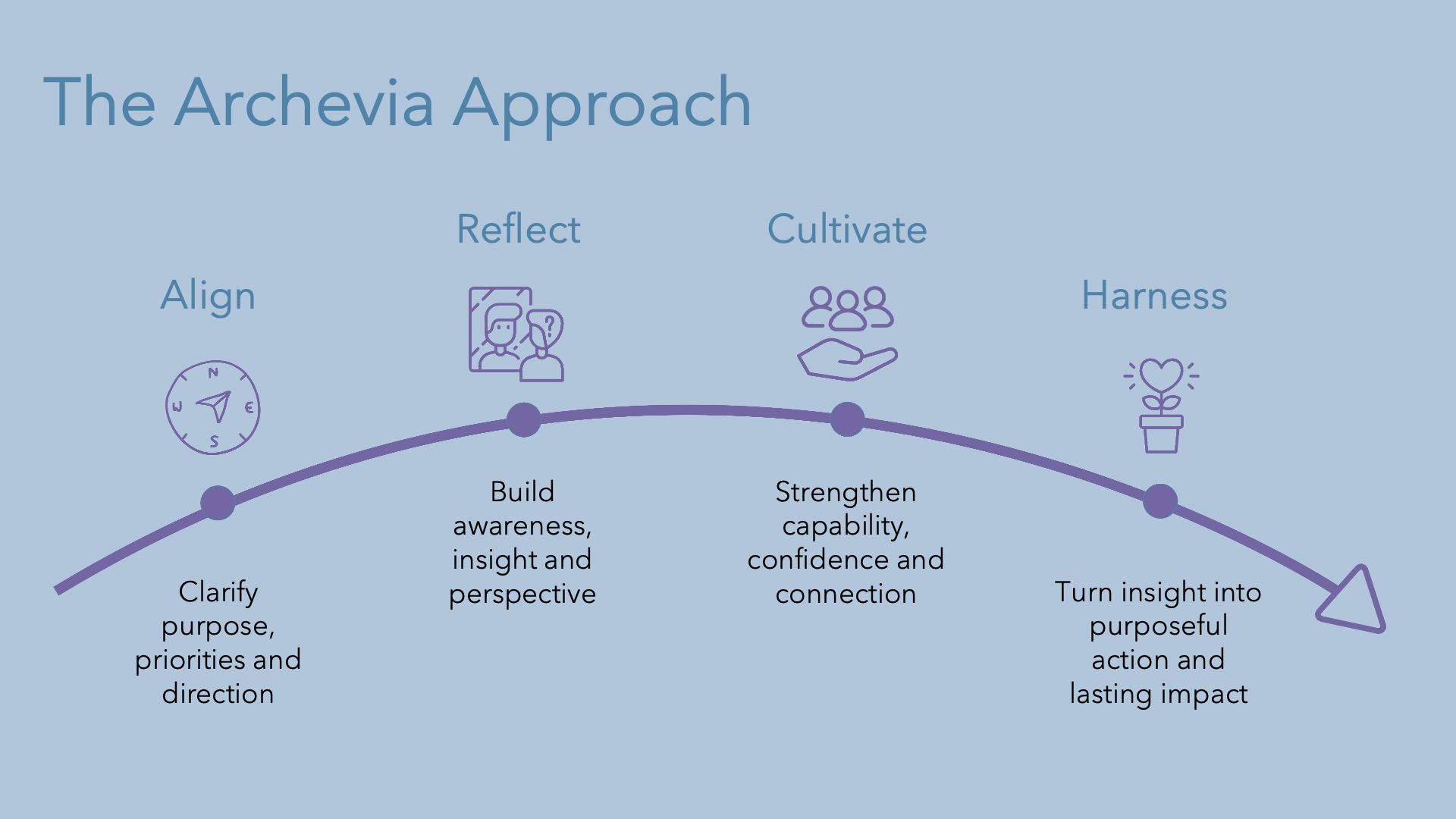
Align: clarify purpose, priorities and direction
Alignment begins with understanding what matters.
For an individual, this might mean becoming clearer about personal values, priorities or the kind of impact they want to have.
For a leader, it may mean considering what their role now requires, where their attention is needed and what they want to create for the people around them.
For a team, alignment can involve developing a shared understanding of purpose, expectations and priorities.
Without this clarity, it is possible to stay busy working on the wrong things without making meaningful progress. People can also be working hard while moving in different directions.
Alignment does not require everyone to think the same way. It means creating enough shared understanding to make thoughtful decisions about where to focus and how to move forward.
Some useful questions might be:
What's taking up the most space in your thinking right now?
What matters most here?
What are we trying to achieve or strengthen?
Where is our attention currently going?
Is there a gap between what we say matters and what our actions suggest matters?
What would meaningful progress look like?
Alignment gives us direction. Reflection helps us look more closely at what may be shaping our current experience.
Reflect: build awareness, insight and perspective
Reflection creates space to pause, notice and look at something differently.
In workplaces that value activity, responsiveness and problem-solving, taking time to reflect can sometimes feel like stepping away from the real work. Often, however, it is what allows us to approach the work with greater clarity.
Reflection helps us recognise patterns, assumptions and habits that may otherwise remain unseen. It gives us an opportunity to learn from experience, consider different perspectives and notice where our intentions and our impact may not be the same.
For someone moving from technical expert to people leader, reflection might reveal how closely their sense of value has been connected to knowing the answer or solving the problem themselves.
For an established leader, it may create greater awareness of how their behaviour affects the people and environment around them.
For a team, reflection may bring attention to patterns in communication, decision-making or trust that have developed over time.
Coaching conversations, feedback, assessments and facilitated discussions can all support reflection. Their value is not simply in providing more information. It comes from helping people understand what that information means for them.
Questions that may support reflection include:
What patterns are becoming visible?
What assumptions might we be making?
What are we learning from our experience?
What might we see if we considered another perspective?
What are we overlooking or taking for granted?
Reflection can create important insight. The next step is considering what needs to be strengthened.
Cultivate: strengthen capability, confidence and connection
Growth takes time, attention and practice.
We cultivate something by creating the conditions in which it can develop. This might include support, feedback, new experiences, honest conversations and opportunities to try a different approach.
For an individual, this could mean building confidence, greater self-awareness or a different way of responding to uncertainty.
A leader may need to strengthen their ability to delegate, have meaningful conversations or create more space for others to contribute.
A team may need to develop greater trust, clearer ways of working or stronger connections between people.
This is where development moves beyond understanding an idea. New approaches need to be tried in real situations. People need opportunities to practise, receive feedback, adjust and try again.
Cultivation is also not only about addressing weaknesses or gaps. It includes recognising and building on the strengths, experience and capability that already exist.
Some useful questions might be:
What needs to be strengthened or practised?
What capability or confidence would support the next stage of growth?
What relationships or conditions need attention?
What existing strengths can we build upon?
What support would help a new practice take hold?
Cultivation helps turn awareness into something people can use. Harnessing is about carrying that learning into action.
Harness: turn insight into purposeful action and lasting impact
Insight becomes valuable when it influences what we do.
Harnessing brings together what has become clearer, what has been learned and what has been strengthened. It is about applying these things through purposeful action.
This might mean making a different choice, beginning an important conversation, changing a leadership habit or introducing a new team practice.
Sometimes it involves a significant step. At other times, lasting change begins with something small and intentional.
The aim is not simply to complete a coaching engagement, leadership program, workshop or team session. The value lies in what people take forward and continue to use.
This is also why the pathway continues beyond Harness. Growth does not finish when Archevia’s involvement ends.
The awareness, confidence, relationships and practices developed through the work should continue to support people as they respond to new situations and opportunities.
Questions to consider include:
What will we do differently as a result of what we have learned?
What is one purposeful next step?
How can this be applied in everyday work?
What might get in the way?
What will help the change continue?
How will we recognise meaningful progress?
A connected approach to growth
Align, Reflect, Cultivate and Harness are shown as a pathway, but growth is rarely perfectly linear.
Reflection may change what we need to align around. Practising something new may create further insight. Taking action may reveal another area that needs attention.
Different people and teams may also begin in different places.
Sometimes the immediate need is greater clarity. Sometimes people know what matters but need space to think. At other times, there is already considerable insight, but support is needed to translate it into action.
The Archevia Approach provides a structure without assuming that every person or situation is the same. It creates space to understand the context, recognise what is most important and shape the work around what is genuinely needed.
Where might you begin?
Meaningful growth does not always begin with knowing exactly what to do.
It may begin by becoming clearer about what matters, creating space to see something differently, strengthening what is needed or choosing one purposeful action.
Consider your own situation, leadership or team:
Where might greater alignment, reflection, cultivation or purposeful action make the biggest difference right now?
If you would like to explore that question, let’s start with a conversation.
